Simplifying event-day operations for staff and volunteers
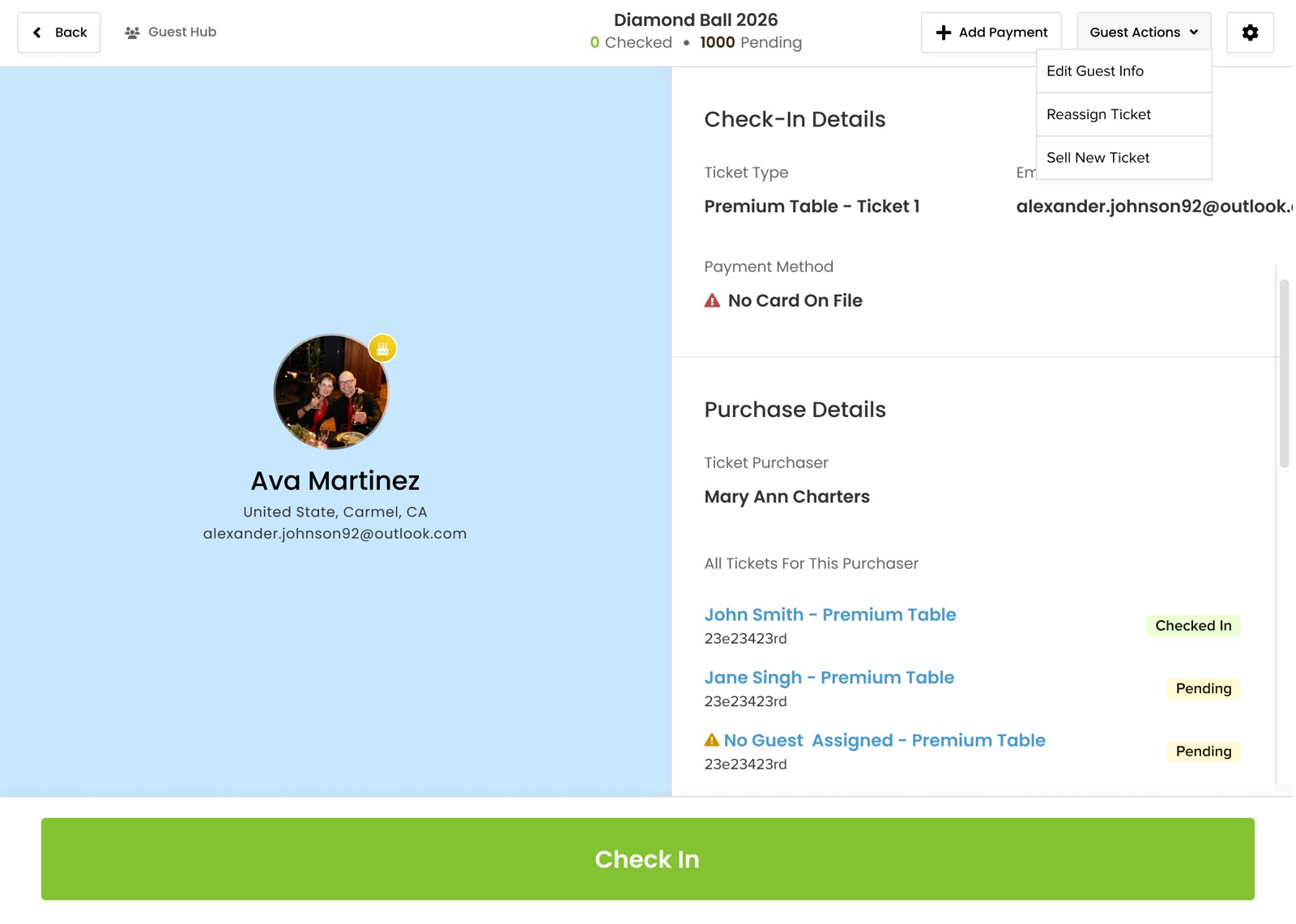
Event-day staff often juggle multiple tools to check in guests, manage tickets, process onsite sales, and resolve attendee issues. I helped design Guest Hub, a centralized experience that brings guest lookup, check-in, ticket management, and onsite sales into a single workflow.
- Led UX and interaction design
- Defined workflows for check-in and ticket management
- Collaborated with Product, Engineering, QA, and CX
- Created wireframes, prototypes, and final designs
The problem
Tickets tracked who paid, not who was attending. Staff couldn't see the real guests behind a purchase.
The shift
Assign every ticket to a real guest, then give staff one place to find and help them.
The result
Staff got faster access to guest info at check-in.
Event staff needed better visibility into attendees
Many fundraising events sell multiple tickets in a single purchase. While the system tracked the purchaser, it didn't provide a clear way to identify the actual attendees associated with each ticket.
This created challenges for event-day staff who needed to quickly understand who was attending, manage guest lists, prepare attendees for fundraising activities, and support guests during check-in, especially at galas and auctions where one purchaser could manage tickets for a whole table.
What I aimed to achieve
Improve attendee visibility
Help organizations understand who is attending an event, not just who purchased tickets.
Support guest management
Associate attendees with tickets and manage guest information before event day.
Streamline event-day operations
Give staff quick access to the information and actions needed during check-in and guest support.
Constraints
Existing ticketing model
The platform was designed around purchasers and tickets rather than attendees.
Event-day efficiency
Staff needed to act quickly in busy, high-volume event environments.
Multiple event types
It had to work across galas, auctions, fundraising events, and other ticketed experiences.
Understanding fundraising event operations
Guest Hub wasn't created from scratch. It evolved from an existing ticketing experience as the company expanded its focus within the fundraising space.
Through conversations with Customer Experience teams, observation of fundraising events, and a deeper understanding of auction and gala workflows, we found a recurring challenge: organizations needed visibility into attendees, not just ticket purchasers. That visibility mattered for:
Shifting from purchaser-centric to attendee-centric workflows
The platform was built around purchasers and tickets. A table of ten looked like one buyer.
Attendee assignment lets each ticket belong to a specific guest, not only the purchaser.
Centralizing guest management into a single experience
Guest information and event-day actions were spread across separate workflows, so helping one guest meant jumping between screens.
Guest Hub became one place for guest lookup, ticket management, attendee visibility, and check-in.
From managing tickets to managing attendees
Improved attendee visibility
Organizations could identify the attendees on each ticket instead of relying only on purchaser information.
Better event-day operations
Staff got faster access to the guest information needed for check-in and guest support.
Foundation for what came next
Attendee visibility enabled ticket transfers, bidder registration, and fundraising participation.
Event staff aren't managing tickets. They're managing people.
Designing for people, not records
The platform managed tickets well, but staff needed to manage attendees. That distinction redefined the experience.
Clarity above all else
Event-day staff work under time pressure. Clear information architecture proved more valuable than adding new functionality.
Small changes, large openings
Improving attendee visibility unlocked guest management, fundraising, and future event experiences.